
Bristol Hannover Council
Bristol-fashion welcome for the Ambassador
** On Wednesday, April 15 the German Ambassador Her Excellency Susanne Baumann visited Bristol. A busy day included visits to Bristol University and its Max Planck Institute, the Bristol City Council and Airbus. The last event on the itinerary was a talk which Frau Baumann gave at Bristol University. The talk was jointly hosted by the Bristol-Hannover Council and the Bristol Anglo-German Society and ably orchestrated by Mark Bright-Allinson.
The audience included members of both societies, as well as invited guests from Anglo-German twinning associations in the region, including representatives from Patchway, Taunton, Bath, Bradford on Avon and Clevedon. Also attending was Jyles Allen, newly-elected president of the Bristol Junior Chamber and Eleanor Whitwam, who represented Bristol at the recent UK-Germany Youth Summit in Berlin.
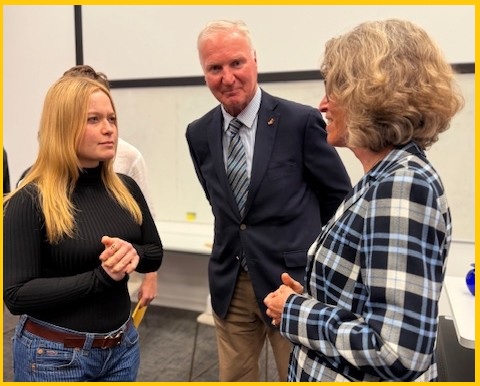
The ambassador was welcomed by two British students from Bristol University’s German department, speaking fluently in German, and by Bristol’s Vice-Chancellor Professor Evelyn Welch, who referred in her speech to the prominent role played by the University’s Professor August Closs in leading a delegation from Bristol to war-ravaged Hannover in 1947, a visit which lead to the creation of the Bristol-Hannover Council, one of the UK’s oldest twinning relationships.
Frau Baumann said that relations between the UK and Germany were now in a dynamic phase. She referred to the state visit of the President of Germany, Herr Frank-Walter Steinmeier, in 2025, and the conclusion of the Kensington Treaty – the first bi-lateral treaty between our two countries since the Heligoland-Zanzibar Treaty of 1890.
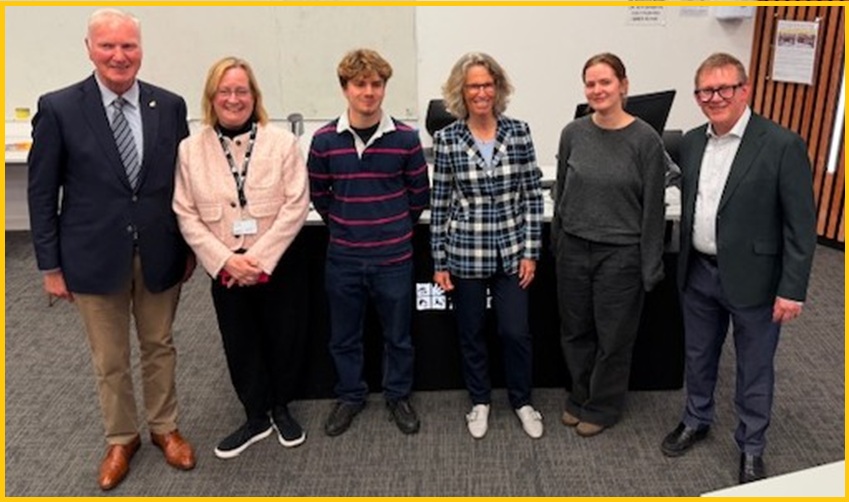
The Ambassador said that much had changed in the last 10 years since the Brexit referendum. Both countries had to come to terms with a drastically changed geo-political landscape and multiple uncertainties in the near future. It made sense to look for ways to cooperate to meet these challenges. The Kensington Treaty offered new possibilities for working together, not least by facilitating exchanges between young people.
The ambassador’s talk lead to a lively discussion, with the audience contributing their views freely. Among topics discussed were how to re-invent twinning to make it relevant for young people and how to promote language learning in schools after a long term decline. In this context, it was particularly enlightening to hear from the students of German present who were ‘swimming against the tide’.
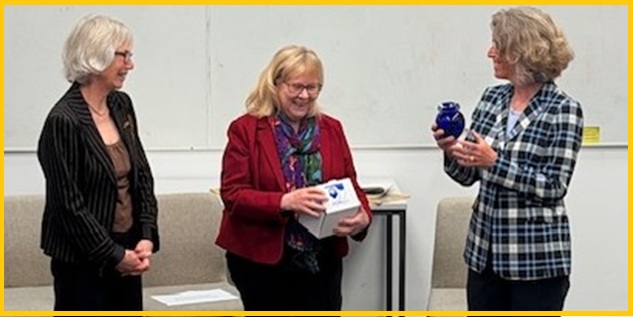
At the end of the event, the Ambassador was presented (above) with a small vase of Bristol Glass by Ann Kennard of Bristol-Hannover Council and Angela Greenwood of Bristol Anglo-German Society as a memento of her visit to the city. The Ambassador thanked the organisers and promised to return to Bristol in 2027 for the celebrations of the 80th Anniversary.
IAN TURNER
#####


